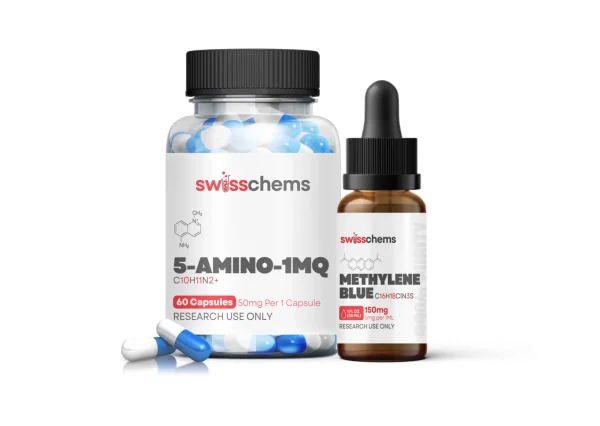
Buy high-quality 5-Amino-1MQ and Methylene Blue longevity research bundle for sale. ≥99% purity, HPLC-verified, COA included. Buy powerful NAD+ pathway and mitochondrial research compounds. 36-month shelf life. Fast shipping to USA, Canada, Germany, France & beyond.
You are from United States (US), price will be in United States (US) dollar ($).
Buy Longevity Research Bundle For Sale | 5-Amino-1MQ + Methylene Blue | Fast Shipping
Your cells are aging right now. Not dramatically — quietly. NAD+ levels drop roughly 1% per year after age 30. Mitochondria get slower. Fat cells get bigger. Muscle takes longer to repair. The science of longevity research exists precisely to understand why these things happen — and what compounds interact with those pathways at the cellular level.
This Longevity Research Bundle pairs two of the most talked-about compounds in modern metabolic and cellular health research: 5-Amino-1MQ — a selective NNMT inhibitor that works upstream in the NAD+ salvage pathway — and Methylene Blue — an FDA-recognized redox agent with over 150 years of documented research history. Together, they target two distinct but complementary longevity pathways: NAD+ preservation and mitochondrial electron transport optimization. Different mechanisms. Same goal. More complete research coverage.
Both compounds ship from Swiss Chems Official as research-grade material — ≥99% HPLC-verified purity, third-party COA included, 36-month shelf life, fast shipping to the USA, Canada, Germany, France, Australia, and most international destinations.
Mitochondrial electron transport chain, oxidative stress, ATP production
36 months
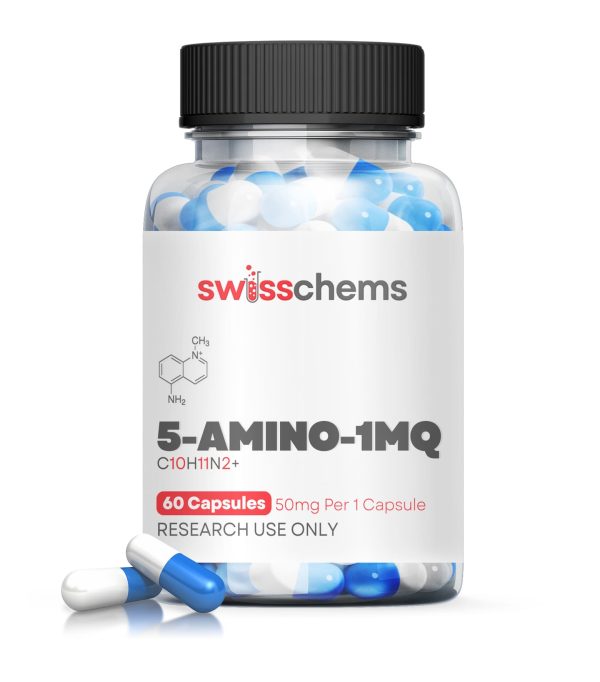
5-Amino-1MQ (5-Amino-1-Methylquinolinium) For Sale – Buy Now
What Is 5-Amino-1MQ?
5-Amino-1MQ (5-amino-1-methylquinolinium, CAS 42464-96-0) is a small, membrane-permeable molecule first characterized by researchers at the University of Texas in 2017 while searching for ways to selectively inhibit nicotinamide N-methyltransferase (NNMT) — an enzyme highly active in fat tissue and central to cellular energy homeostasis.
Here’s why NNMT matters. As fat cells grow larger, they overproduce NNMT. That overproduction creates what researchers call a “methyl sink” — NNMT consumes S-adenosyl methionine (SAM) and nicotinamide (NAM), draining both away from NAD+ synthesis. Less NAD+ means slower mitochondrial function, reduced SIRT1 activity, impaired DNA repair, and more fat storage. It’s a cycle that feeds itself — and aging accelerates it.
5-Amino-1MQ breaks that cycle. By selectively blocking NNMT, it preserves NAM for the NAD+ salvage pathway, raises intracellular NAD+ levels, restores SAM availability, and activates SIRT1 — the protein often called the “longevity gene” because of its role in DNA repair, inflammation regulation, and metabolic function.
What makes it particularly useful for research? It’s highly selective. In preclinical studies, 5-Amino-1MQ did not inhibit related SAM-dependent methyltransferases or other enzymes in the NAD+ salvage pathway — meaning its NNMT-targeting is clean, with a well-defined mechanism and reproducible biochemical readouts.
How NNMT Inhibition Works — Step by Step
Stage
What Happens Without 5-Amino-1MQ
What Happens With 5-Amino-1MQ
NNMT Activity
High — converts NAM to 1-MNA, draining methyl donors
Blocked — NAM preserved for NAD+ synthesis
Intracellular NAD+
Reduced — less fuel for mitochondria and sirtuins
Elevated — more available for energy and repair
SAM Levels
Depleted — methylation capacity compromised
Preserved — epigenetic regulation supported
SIRT1 Activity
Low — DNA repair, fat oxidation suppressed
Activated — longevity pathway engaged
Adipocyte Function
Large fat cells, lipogenesis dominant
Smaller fat cells, fat oxidation promoted
GLUT4 Expression
Low — glucose uptake impaired
Increased — improved glucose clearance
5-Amino-1MQ Research Data — What Studies Show
The data on 5-Amino-1MQ comes primarily from preclinical animal models. No human clinical trials have been published yet — but the mechanistic case and animal outcomes are compelling enough that researchers across metabolic health, longevity, and muscle biology are studying it actively.
Obesity and Fat Mass (DIO mouse model, Biochem Pharmacol, 2018): In diet-induced obese mice, 5-Amino-1MQ led to 5.1% body weight reduction, a 35% decrease in fat mass, and over 30% smaller adipocytes — all without any change in food intake. Lean mice showed no significant weight change, suggesting the compound’s effects are most pronounced in states of metabolic dysfunction. (Neelakantan et al., 2018)
Insulin Sensitivity (PMC, 2021): NNMT inhibition reduced fasting insulin serum levels by 50–60% in obese mouse models, alongside reduced triglycerides, free fatty acids, and normalized glucose tolerance. (Gao et al., PMC, 2021)
Muscle Strength and Aging (Scientific Reports, 2024): In a study from the University of Texas Medical Branch, 5-Amino-1MQ improved grip strength in aged mice better than rigorous exercise alone. When combined with exercise training, daily running distance increased by ~150% and was sustained — versus ~75% with exercise alone that tapered off. Researchers noted the compound appeared to reduce the need for muscle recovery following vigorous activity. (Dimet-Wiley et al., Sci Rep, 2024)
Microbiome and Metabolic Profile (Nature): Combining an NNMT inhibitor with a lean/low-fat diet normalized body weight and adiposity in obese mice more completely than diet alone, and established a distinct lean-like microbiome profile — suggesting potential applications in diet-compound interaction studies. (Nature, cited in Protide Health, 2026)
Oral Bioavailability: Research confirms 5-Amino-1MQ demonstrates 38.4% oral bioavailability with a half-life of 6.9 hours (oral) and 3.8 hours (IV) — supporting its viability as an orally administered research compound in animal models.
Competitive inhibition of NNMT; NAD+ salvage pathway modulation
Purity
≥99% HPLC verified
Form
Lyophilized powder
Solubility
Water soluble (charged quaternary nitrogen)
Membrane Permeability
High — crosses cell membranes selectively
Oral Bioavailability
38.4% (animal models)
Half-Life
~6.9 hours (oral); ~3.8 hours (IV)
Storage
−20°C preferred; cool, dry, dark environment acceptable
Shelf Life
36 months
Intended Use
In vitro laboratory research only
How to Reconstitute 5-Amino-1MQ
Unlike peptide-based compounds, 5-Amino-1MQ is a small molecule with good water solubility — reconstitution is straightforward.
What You’ll Need
Item
Purpose
5-Amino-1MQ vial (lyophilized)
Your research compound
Sterile water or bacteriostatic water
Reconstitution solvent
Sterile syringe
Volume measurement
Alcohol swabs (70% IPA)
Stopper disinfection
Nitrile gloves + safety goggles
Iodide salt form is a chemical irritant — handle with care
Step 1 — Safety First
5-Amino-1MQ iodide salt is classified H302 (harmful if swallowed), H315 (skin irritant), H319 (serious eye irritant). Always wear nitrile gloves and safety goggles before handling. Work in a clean, controlled environment.
Step 2 — Disinfect the Vial Stopper
Wipe with a 70% IPA alcohol swab. Let it dry for 30 seconds before inserting the needle.
Step 3 — Add Sterile Water
Draw your target volume of sterile or bacteriostatic water and inject slowly into the vial. 5-Amino-1MQ dissolves readily in aqueous solution — no vigorous mixing required.
Step 4 — Swirl Until Clear
Gently swirl the vial for 1–2 minutes. The solution should dissolve fully and appear clear. No need to heat or sonicate — water solubility is a key property of this compound.
Step 5 — Label and Store
Label with date, concentration, and lot number. Store at 2–8°C for short-term use, or −20°C for extended storage. Avoid repeated freeze-thaw cycles and protect from light.
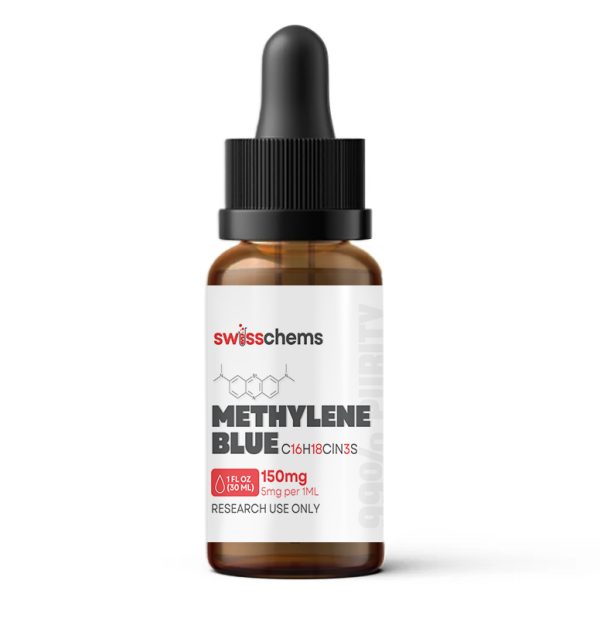
Buy Methylene Blue For Sale – Research Grade | Fast Shipping
What Is Methylene Blue?
Methylene Blue (methylthioninium chloride, CAS 61-73-4) was first synthesized in 1876 as a textile dye. It became the world’s first fully synthetic therapeutic drug — used to treat malaria, methemoglobinemia, and cyanide poisoning. Today it’s FDA-approved for methemoglobinemia and carries over 150 years of documented use. But it’s the why behind its modern resurgence in longevity and mitochondrial research that makes it genuinely fascinating.
Think of Methylene Blue as a backup power cable for your cells’ power plants. Here’s how it works: inside the mitochondria, electrons flow through the electron transport chain (ETC) to produce ATP — your cell’s energy currency. When segments of that chain are damaged or stressed by age, disease, or oxidative load, electron flow slows. Electrons leak. They react with oxygen to form reactive oxygen species (ROS) — the molecules that damage DNA, accelerate aging, and degrade cellular function.
Methylene Blue is a redox molecule. It cycles between its oxidized form (methylthioninium, the blue form) and its reduced form (leucomethylene blue, colorless). This cycling lets it act as an alternative electron carrier — it can bypass damaged ETC segments, donate electrons directly to cytochrome c (Complex IV), and sustain ATP production even under cellular stress (Gonzalez-Lima et al., University of Texas; Tucker et al., Mol Neurobiol, 2018).
Unlike standard antioxidants that neutralize one ROS molecule and are consumed, Methylene Blue is a reusable antioxidant — it cycles between oxidized and reduced states continuously, providing sustained protection against oxidative damage in a way most compounds cannot replicate.
“Methylene blue acts as a redox mediator, capable of bypassing dysfunctional segments of the electron transport chain to sustain ATP production and reduce reactive oxygen species.” — Dr. Francisco Gonzalez-Lima, Professor of Neuroscience, University of Texas at Austin — whose foundational research catalyzed modern interest in Methylene Blue’s neurometabolic applications
Methylene Blue Research Data — The Evidence
Mitochondrial ATP Production: In cell culture and animal models, low doses (0.5–4 mg/kg) of Methylene Blue increased cellular oxygen consumption by up to 70% and boosted ATP production by approximately 30% (Healthspan Research Review, 2025). A 2025 study published in the Journal of Molecular Pharmacology confirmed that Methylene Blue increased active mitochondria in cardiomyocyte models, reversed H₂O₂-induced oxidative damage, and modulated antioxidant gene expression (MDPI, July 2025).
Cytochrome Oxidase Activity: A single 1 mg/kg injection in rats resulted in a 30% increase in cytochrome oxidase (CO) activity in brain tissue after 24 hours. CO is a key mitochondrial enzyme — its enhancement is directly linked to improved neuroenergetic function and memory consolidation.
Lifespan Research:Methylene Blue led to a significant increase in “maximal lifespan” (proportion of mice alive at the 90th percentile) in genetically diverse UM-HET3 female mice in a study published in Aging (Poudel et al., Aging, 2024). The same study found it improved skeletal muscle function and targeted mitochondrial dysfunction in aging tissue.
Memory and Cognition (Animal Models): In the Morris water maze, Methylene Blue reversed scopolamine-induced memory deficits and improved performance in mouse models of Alzheimer’s disease. Rats receiving 1–4 mg/kg after task exposure showed significant memory retention 24 hours later, associated with increased metabolic activity in the hippocampus and prefrontal cortex.
Alzheimer’s Disease Research: Dr. Gonzalez-Lima’s research proposes that Alzheimer’s disease is fundamentally a disorder of mitochondrial hypometabolism — not just amyloid plaques. Methylene Blue is being explored as a tool to investigate this metabolic bottleneck hypothesis. In vitro, it reduces mitochondrial superoxide production and mitigates free radical formation.
Skin and Cellular Aging: In cells from progeria patients (accelerated aging disorder), Methylene Blue corrected mitochondrial and nuclear defects — showing it can act on fundamental cellular aging pathways. Scientific Reports published research confirming anti-aging potentials of Methylene Blue for human skin longevity.
Methylene Blue Technical Specifications
Parameter
Detail
Chemical Name
Methylthioninium chloride
CAS Number
61-73-4
Molecular Formula
C₁₆H₁₈ClN₃S
Molecular Weight
319.85 g/mol
PubChem CID
6099
Synonyms
Basic Blue 9, Solvent Blue 8, methylthioninium chloride
Class
Phenothiazine-derived synthetic redox agent
Mechanism
Alternative electron carrier in mitochondrial ETC; redox cycling between MB⁺ (oxidized) and MBH₂ (reduced) forms
Methylene Blue degrades on exposure to light. Keep vials wrapped in foil or use amber glass. Work efficiently and minimize open exposure time.
Step 2 — Disinfect the Stopper
Wipe with 70% IPA. Let dry 30 seconds before proceeding.
Step 3 — Add Sterile Water Slowly
Methylene Blue dissolves readily in water. Inject your target volume slowly against the vial wall. The solution will turn blue immediately — that’s normal and expected.
Step 4 — Swirl Gently Until Homogeneous
A few seconds of gentle swirling is all that’s needed. No heating or sonication required. The characteristic blue color should be uniform throughout — no undissolved particles.
Step 5 — Inspect and Label
The solution should be a clear, deep blue — no cloudiness, no precipitate. Label immediately: date, concentration, lot number. Wrap in foil or store in an amber container to protect from light degradation.
Step 6 — Store at 2–8°C, Protected From Light
Refrigerate immediately after preparation. Use within 28 days. Do not freeze the reconstituted solution. Note: Methylene Blue solutions can stain surfaces and skin — handle carefully and dispose of properly.
How to Store Both Compounds
Compound
Lyophilized Storage
Reconstituted Storage
Shelf Life
Light Sensitivity
5-Amino-1MQ
−20°C preferred; cool dry dark acceptable
2–8°C; up to 28 days
36 months
Moderate — avoid direct light
Methylene Blue
−20°C or cool, dry, dark environment
2–8°C; up to 28 days; amber container
36 months
High — always protect from light
Why These Two Compounds Work Well Together in Research
NAD+ and Methylene Blue work through different but complementary mechanisms — and that’s exactly why researching them together is gaining traction in longevity science.
Mechanism
5-Amino-1MQ
Methylene Blue
Primary target
NNMT enzyme — upstream NAD+ preservation
Mitochondrial ETC — electron transport optimization
Neurodegeneration, cellular aging, cognitive function
As one researcher put it: NAD+ gives cells the energy they need. Methylene Blue helps them use that energy more efficiently. 5-Amino-1MQ makes sure NAD+ is there in the first place.
FAQs About the Longevity Research Bundle
1. What is 5-Amino-1MQ and what does it do?
5-Amino-1MQ is a small-molecule NNMT inhibitor — it blocks the enzyme that drains NAD+ in fat and aging tissue. By inhibiting NNMT, it preserves nicotinamide for NAD+ synthesis, activates SIRT1, and supports fat oxidation and cellular energy at a metabolic level. In animal models, it reduced fat mass by 35% and improved grip strength beyond what exercise alone achieved.
2. What is Methylene Blue used for in research?
Methylene Blue is studied as an alternative electron carrier in the mitochondrial electron transport chain. It sustains ATP production under cellular stress, acts as a reusable antioxidant by cycling between oxidized and reduced states, and is explored in models of neurodegeneration, cognitive decline, and cellular aging. Low doses (0.5–4 mg/kg in animal models) increased ATP production by ~30% and raised cytochrome oxidase activity by ~30% in brain tissue
3. Is Methylene Blue safe for research use?
At low doses, Methylene Blue has a well-documented safety profile with over 150 years of clinical use. However, at high doses it disrupts the mitochondrial ETC and can be toxic. It interacts with at least 196 drugs — 129 of which are classified as major interactions. Most critically: it must never be used with serotonergic drugs (SSRIs, SNRIs, MAOIs) due to serious serotonin syndrome risk (Alzheimer’s Drug Discovery Foundation, 2025; NPR, 2025). For research purposes, strict protocol control and dose management are essential.
4. Does 5-Amino-1MQ work without diet changes?
In preclinical animal research, 5-Amino-1MQ reduced body weight, fat mass, and adipocyte size without any change in food intake. This makes it particularly interesting for research protocols studying cellular fat metabolism independent of caloric restriction. Lean mice in control groups showed no significant weight change, confirming the effect is most pronounced in metabolically dysfunctional states.
5. Can Methylene Blue cross the blood-brain barrier?
Yes. Because of its small molecular size, lipophilicity, and positive charge, Methylene Blue crosses the blood-brain barrier readily and accumulates preferentially in the mitochondrial matrix — especially in metabolically active neurons in the hippocampus and prefrontal cortex. This accumulation is driven by mitochondrial membrane potential and is central to its neuroprotective research applications
6. What does 5-Amino-1MQ do to muscle tissue?
Research published in Scientific Reports (2024) showed 5-Amino-1MQ improved grip strength in aged mice better than rigorous exercise training alone. When combined with exercise, daily running distance increased by ~150% in a sustained manner — versus ~75% with exercise alone that tapered off. Separately, older studies showed a 2-fold increase in myofiber size following NNMT inhibition in muscle stem cell studies
7. What drugs interact with Methylene Blue?
Methylene Blue interacts with at least 196 drugs — the most serious category involves serotonergic drugs. Using it alongside SSRIs (e.g., sertraline, escitalopram), SNRIs, MAOIs, or tricyclic antidepressants can cause serotonin syndrome — a potentially life-threatening reaction involving elevated blood pressure, seizures, and cardiac events. It also interacts with anticoagulants and drugs with narrow therapeutic windows. These interactions are critical research protocol design considerations.
8. Is 5-Amino-1MQ FDA-approved?
No. 5-Amino-1MQ has not entered human clinical trials and is not FDA-approved for any medical use. The FDA has explicitly classified it as an unapproved new drug. It is available from verified suppliers for qualified laboratory research use only — not for human consumption or therapeutic application.
9. How does Methylene Blue compare to NAD+ in longevity research?
They operate through different mechanisms that are often studied as complementary. NAD+ (or its precursors NMN/NR) provides the fuel for mitochondrial and sirtuin function. Methylene Blue acts as a mitochondrial optimizer — helping cells use that fuel more efficiently by keeping electron flow moving even when ETC components are damaged. Many longevity research protocols explore both pathways simultaneously for broader mechanistic coverage (Relive Health, 2025). 5-Amino-1MQ adds a third layer by ensuring NAD+ isn’t drained by NNMT in the first place.
10. How long is the shelf life of compounds in this bundle?
Both 5-Amino-1MQ and Methylene Blue in this bundle carry a 36-month shelf life in lyophilized powder form when stored correctly. 5-Amino-1MQ stores at −20°C or a cool, dry, dark environment. Methylene Blue requires protection from light throughout storage and use — degradation is accelerated by light exposure. Once reconstituted, both compounds should be used within 28 days and stored at 2–8°C.
11. What is NNMT and why does it matter for aging?
NNMT (nicotinamide N-methyltransferase) is an enzyme that converts nicotinamide into 1-methylnicotinamide — consuming both NAM and SAM in the process. In aging tissue and obese fat cells, NNMT is overexpressed, which drains both of these molecules away from critical cellular functions: NAM away from NAD+ synthesis, SAM away from methylation reactions. This creates a compounding metabolic deficit. High NNMT activity is documented in human obesity and insulin resistance (Gao et al., PMC, 2021). Inhibiting it with 5-Amino-1MQ restores that balance in experimental models.
12. Why is Methylene Blue blue?
Methylene Blue is blue in its oxidized state (methylthioninium) because it absorbs red and orange wavelengths of visible light. In its reduced form (leucomethylene blue), it becomes colorless. This visual redox indicator property is actually one of its earliest research applications — it was used as a staining agent in early microscopy. Today, its redox-cycling chemistry is what makes it valuable in mitochondrial and antioxidant research. Fair warning: it will turn your tongue and urine blue during lab handling. Not a side effect anyone forgets.
⚠️ Research Use Only: All products in this bundle are intended strictly for in vitro laboratory research by qualified professionals. Not for human or animal consumption. Not evaluated or approved by the FDA for therapeutic use. Handle with appropriate safety protocols. 5-Amino-1MQ iodide salt is a chemical irritant — wear gloves and eye protection. Methylene Blue interacts with numerous drugs — review interaction profiles before incorporating into any research protocol.
2 reviews for Longevity Research Bundle
Rated 4 out of 5
Angel (verified owner)–
Quick dispatch and legit products that meet expectations.
Rated 5 out of 5
Michael (verified owner)–
It gives off a real and credible vibe compared to other sites.

Angel (verified owner) –
Quick dispatch and legit products that meet expectations.
Michael (verified owner) –
It gives off a real and credible vibe compared to other sites.