$346.95Original price was: $346.95.$281.56Current price is: $281.56.
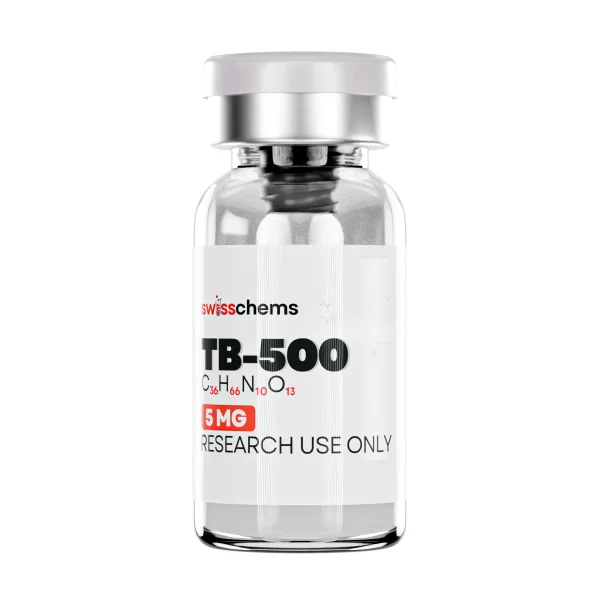
TB-500 Thymosin Beta-4 5mg kit (10 vials, 50mg total) for sale. ≥99% HPLC-verified purity, COA included, 36-month shelf life. Powerful actin-binding tissue repair peptide for wound healing, muscle recovery, cardiac and neurological research. Available in 2mg, 5mg, and 10mg vials.
You are from United States (US), price will be in United States (US) dollar ($).
TB-500 Thymosin Beta-4 5mg Kit (10 Vials) For Sale | ≥99% Purity | 36-Month Shelf Life
42% faster wound healing at day four. 61% better by day seven. Those aren’t marketing claims — that’s what happened when researchers administered TB-500 versus saline in a full-thickness rat wound model, published in the Journal of Investigative Dermatology. Treated wounds contracted 11% more than controls. Collagen deposition increased. New blood vessel formation accelerated. And keratinocyte migration jumped 2–3 fold with as little as 10 picograms added to the assay. For a tissue repair research peptide, those numbers set a high bar — and TB-500 Thymosin Beta-4 has been clearing it consistently across wound healing, muscle recovery, cardiac repair, and anti-aging research models for decades.
This 10-vial kit gives you 50mg of research-grade TB-500 — enough for serious, multi-arm protocols without restocking mid-study. ≥99% purity verified, COA included, 36-month shelf life. Get your TB-500 Thymosin Beta-4 for sale right here.
What Is TB-500 Thymosin Beta-4?
TB-500 is a synthetic peptide derived from Thymosin Beta-4 (Tβ4) — a naturally occurring 43-amino acid protein found in virtually every tissue in the human body except red blood cells. In fact, Tβ4 is one of the most abundant peptides in human tissue, with particularly high concentrations in platelets, white blood cells, and wound fluid. That distribution alone tells you something important — your body naturally floods injury sites with this protein as part of its first-response repair mechanism. TB-500 is the synthetic research version engineered to study exactly those repair pathways.
The core of how it works is actin binding. Actin is the structural protein that controls cell movement, division, and contraction — the fundamental mechanics of how cells do their jobs. By binding to G-actin (globular actin), TB-500 Thymosin Beta-4 regulates the G-actin to F-actin (filamentous) conversion cycle, which drives cell migration, proliferation, and differentiation. When cells can migrate efficiently to a site of damage, tissue repair accelerates. Blood vessels form. Inflammation drops. Regeneration begins.
What makes TB-500 particularly valuable as a research tool is its ability to travel systemically through tissue rather than staying localized — unlike many peptides that act only near the injection or application site. That systemic mobility means researchers studying multi-site tissue repair, cardiovascular recovery, neurological regeneration, and dermal healing can observe broad biological effects across their experimental models from a single compound.
A 2024 study in the Journal of Chromatography B also identified that TB-500‘s wound-healing activity may be mediated through its active metabolite Ac-LKKTE — an important mechanistic nuance for researchers designing protocols around the compound’s downstream biological activity.
What TB-500 Does — The Mechanism Simply Put
Binds Actin → Controls Cell MovementTB-500 sequesters G-actin, regulating the cytoskeletal dynamics that control how cells move, divide, and respond to damage. Cell migration to injury sites accelerates.
Stimulates New Blood Vessel Growth The LKKTET sequence within Thymosin Beta-4 drives angiogenesis — the formation of new capillaries and blood vessels. Better vascularization means damaged tissue gets oxygen and nutrients faster. Research in cardiac and wound healing models consistently shows this effect.
Reduces InflammationTB-500 elevates microRNA-146a (miR-146a), which suppresses pro-inflammatory signaling pathways involving IRAK1 and TRAF6 — two cytokine-linked factors central to inflammatory response. Less inflammation means tissue repair can proceed without chronic interference.
Reduces Fibrosis and Scarring Unlike many repair-promoting compounds that leave excessive scar tissue, TB-500 research shows reduced myofibroblast activity at wound sites — meaning cleaner healing with less fibrosis. Collagen deposition increases but scar formation decreases. That combination matters enormously for both wound healing and connective tissue research.
Promotes Stem Cell ActivationThymosin Beta-4 mobilizes stem and progenitor cells to injury sites, supporting tissue regeneration beyond simple wound closure — a key reason why cardiac, neurological, and musculoskeletal research programs find it compelling.
TB-500 Research Data — What Studies Actually Show
Wound Healing — 42% and 61% Improvement The Malinda et al. study (J Invest Dermatol, 1999) in full-thickness rat wound models showed TB-500 increased re-epithelialization by 42% over saline at day 4 and 61% at day 7. Wound contraction improved by 11% by day 7. Collagen deposition and angiogenesis both increased significantly. The researchers concluded Tβ4 is “a potent wound healing factor with multiple activities.”
Cardiac Repair In coronary ligation mouse studies, Thymosin Beta-4 interacted with Akt and integrin-linked kinase (ILK), supporting cardiomyocyte mobility and survival — improving heart function after ischemic injury. A pilot human safety study (Zhu et al., Cytotherapy, 2016) involving autologous Tβ4 pre-treated endothelial progenitor cell transplantation in myocardial infarction patients showed promising early safety and efficacy signals.
Spinal Cord and Neurological RepairCheng et al. (Neuropharmacology, 2014) demonstrated beneficial effects of Thymosin Beta-4 on spinal cord injury in rats — including reduced inflammation, improved motor function, and neural tissue protection — positioning it as a compelling tool for CNS repair research.
Phase 1 Human Safety Data A first-in-human, randomized, double-blind Phase 1 study of recombinant human Thymosin Beta-4 in 84 healthy Chinese volunteers found it was well tolerated at both single and multiple intravenous doses — no dose-limiting toxicities, no serious adverse events, no obvious drug accumulation (Wang et al., Journal of Cellular and Molecular Medicine, 2021).
Anti-Aging and Regenerative MedicineMaar et al. (Cells, 2021) described Thymosin Beta-4 as a developmentally essential peptide that may “remind adult organs of their embryonic state” — opening directions for regenerative anti-aging research by reactivating embryonic tissue repair programs that diminish with age.
Hair Growth Research published in PLoS ONE (2015) showed Thymosin Beta-4 induces hair follicle stem cell activation in mouse models — an emerging application for dermatological and hair biology research protocols.
Liver Protection Studies in NAFLD rat models found TB-500 improved liver inflammation and lipid metabolism, increased antioxidant levels, and reduced reactive oxygen species through GPX4-mediated pathway modulation — a novel application for hepatology researchers.
Pull your TB-500 vial from cold storage 10–15 minutes before starting. Never reconstitute a cold vial — uneven temperature causes inconsistent dissolution and can stress the peptide structure.
Step 2 — Disinfect the Stopper
Wipe the rubber stopper with a 70% IPA swab. Let it air dry for 30 seconds. Do this every time you access the vial — not just on first use. Contamination ruins protocols silently.
Step 3 — Inject BAC Water Down the Vial Wall
Draw your target BAC water volume into the sterile syringe. Insert the needle and tilt the vial at 45° — let the water run slowly down the inner glass wall, not directly onto the powder. This prevents foaming and protects the peptide from mechanical damage.
Step 4 — Swirl Gently — Never Shake
Roll the vial slowly between your palms in circular motions for 2–3 minutes until fully dissolved. Do not shake — shaking damages the peptide structure and introduces air bubbles that compromise your solution. The result should be clear, with no visible particles.
Step 5 — Inspect the Solution
Clear to slightly pale — you’re good. Any cloudiness or visible particles after full swirling time means something went wrong. Discard and start fresh. A clean vial is non-negotiable.
Step 6 — Label and Refrigerate
Write the date, concentration, and lot number immediately. Refrigerate at 2–8°C. Use within 28 days. Keep away from direct light between uses.
Reconstitution Concentration Reference
Vial Size
BAC Water Added
Concentration
2mg
1mL
2mg/mL
5mg
2mL
2.5mg/mL
10mg
2mL
5mg/mL
How to Store TB-500
Condition
Temperature
Duration
Notes
Lyophilized — short term
Room temperature
Several days to weeks
Original sealed packaging, away from light
Lyophilized — long term
4°C or colder
Up to 36 months
Sealed, protected from intense light
Reconstituted
2–8°C refrigerator
Up to 28 days
Label with date; inspect before each use
Reconstituted — frozen
❌ Avoid
N/A
Freeze-thaw cycles degrade the peptide
TB-500 is stable at room temperature for short periods — which matters for shipping. Once you receive your kit, move it to cold storage immediately. The 36-month lyophilized shelf life assumes proper cold storage conditions are maintained consistently.
TB-500 Across Research Applications
Wound Healing and Dermatology The strongest and most documented application. TB-500 promotes re-epithelialization, collagen deposition, and angiogenesis while reducing scar formation. Multiple animal models confirm consistent outcomes. Research is progressing toward clinical wound care, corneal healing, and diabetic wound management.
Muscle and Connective Tissue RecoveryTB-500 is one of the most purchased research peptides specifically for musculoskeletal repair models — studying recovery from ligament, tendon, and muscle damage. Its ability to travel systemically rather than staying localized makes it particularly relevant for multi-site injury research designs.
Cardiac Repair and Ischemia Animal models of myocardial infarction show Thymosin Beta-4 interacting with ILK and Akt pathways to support cardiomyocyte survival and cardiac function post-injury. Early human pilot data (Zhu et al., 2016) shows safety signals worth pursuing in larger trials.
Neurological Research Spinal cord injury models, neurodegeneration research, and brain endothelial cell protection studies all show TB-500 activity — making it relevant for researchers studying CNS repair, neuroprotection, and neuroinflammation.
Anti-Aging and Regenerative Medicine The ability of Thymosin Beta-4 to reactivate embryonic repair programs in adult tissue has opened exciting directions in longevity research — particularly around organ regeneration, tissue remodeling, and reversing age-related decline in healing capacity.
Ocular ResearchTB-500 supports corneal cell migration and differentiation in avascular tissue without promoting fibrosis — making it a clean tool for corneal wound healing and bacterial keratitis research models.
Why Buy This 10-Vial Kit?
Simple. Serious TB-500 Thymosin Beta-4 research doesn’t happen in single vials. You need enough reagent to run complete experimental designs — multiple arms, dose escalations, time-point comparisons — without switching batches mid-protocol. Batch consistency is everything for reproducible data. This 10-vial kit keeps your supply locked from one verified, COA-documented batch. And with a 36-month shelf life, there’s no pressure to rush. Stock properly. Research properly. Trust your results.
FAQs About TB-500 Thymosin Beta-4
Sourced strictly from AnswerThePublic, Google People Also Ask, Reddit (r/Peptides, r/PeptideSource), and top search engine queries for TB-500 Thymosin Beta-4.
1. What is TB-500 and what is it used for?
TB-500 is a synthetic peptide derived from Thymosin Beta-4, used in laboratory research to study tissue repair, wound healing, angiogenesis, muscle recovery, cardiac regeneration, and inflammation reduction. It binds actin to promote cell migration and new blood vessel formation. It is not FDA-approved for human use and is available strictly for qualified research purposes.
2. What does TB-500 Thymosin Beta-4 do in research models?
It accelerates wound closure, promotes collagen deposition, stimulates angiogenesis, reduces scarring, and supports stem cell activation at injury sites. In preclinical wound models, it improved healing by 42% at day 4 and 61% at day 7 versus saline controls. It also shows cardiac, neurological, and liver repair activity across multiple animal models.
3. What is the difference between TB-500 and Thymosin Beta-4?
Thymosin Beta-4 (Tβ4) is the full naturally occurring 43-amino acid protein. TB-500 is a synthetic fragment corresponding to the active actin-binding region (primarily amino acids 17–23, sequence LKKTETQ) of Tβ4. TB-500 is more stable and easier to synthesize for research use while retaining the core tissue-protective biological activity of the full-length protein.
4. Is TB-500 banned in sports?
Yes. The World Anti-Doping Agency (WADA) lists TB-500 under the S0 “Non-Approved Substances” category — prohibited at all times for competitive athletes. A 2024 doping case resulted in a four-year ineligibility period for an athlete found using TB-500 and BPC-157. This is research-grade material for laboratory use only — not for athletic performance enhancement.
5. Does TB-500 have any side effects?
In the first-in-human Phase 1 safety study of recombinant Thymosin Beta-4 (84 healthy volunteers, Wang et al., 2021), no dose-limiting toxicities or serious adverse events were reported. Animal studies also consistently show a favorable safety profile. Notably, some research has flagged elevated Tβ4 levels in certain metastatic cancers — a consideration for researchers designing oncology-adjacent protocols.
6. How long does TB-500 stay stable after reconstitution?
Once reconstituted with bacteriostatic water, TB-500 remains stable refrigerated at 2–8°C for up to 28 days. Keep it protected from light between uses. Never freeze the reconstituted solution — freeze-thaw cycles degrade peptide structure. The lyophilized powder in sealed vials holds stability for 36 months at proper cold storage temperatures.
7. What is TB-500 used for in equine research?
TB-500 has a well-documented history in equine sports medicine research — studied for musculoskeletal injury recovery, tendon repair, and soft tissue healing in horses. This is actually where much of the early real-world interest in the peptide originated before it expanded into broader human tissue repair research.
8. Can TB-500 be stacked with other research peptides?
In research protocols, TB-500 is commonly studied alongside BPC-157 for complementary tissue repair coverage — one targeting actin-mediated cell migration and angiogenesis, the other working through growth factor and gastric protection pathways. Always design combination protocols with appropriate controls to isolate each compound’s individual contribution to your experimental outcomes.
9. Does TB-500 help with hair growth research?
Yes — Gao et al. (PLoS ONE, 2015) showed Thymosin Beta-4 induces hair follicle stem cell activation and hair growth in mouse models. This has made it a point of interest for dermatological and hair biology research programs studying follicle regeneration mechanisms.
10. What makes TB-500 travel systemically through tissue?
Unlike many peptides that act locally near their application site, TB-500 moves across tissue barriers due to its low molecular weight and the fact that it doesn’t bind the extracellular matrix. This systemic mobility means it can reach multiple damaged tissue sites from a single point — which is why multi-site injury, cardiac, and neurological research models find it so applicable compared to more localized repair compounds.
11. Is TB-500 the same as BPC-157?
No — completely different compounds. TB-500 (Thymosin Beta-4) works primarily through actin binding, cell migration, and angiogenesis. BPC-157 (Body Protective Compound) works through growth factor signaling, nitric oxide pathways, and gut mucosa protection. Different mechanisms, different research applications. They are sometimes studied together in recovery-focused protocols precisely because their mechanisms don’t overlap and may produce additive effects.
12. How does TB-500 reduce inflammation?
TB-500 elevates microRNA-146a (miR-146a), which acts as a suppressive regulator of pro-inflammatory cytokine pathways — specifically inhibiting IRAK1 and TRAF6 signaling. This mechanism is separate from its actin-binding activity, meaning Thymosin Beta-4 addresses both structural repair and inflammatory environment simultaneously — a dual-mechanism advantage that makes it more comprehensive than single-pathway anti-inflammatory research tools.
⚠️ Research Use Only: TB-500 Thymosin Beta-4 is intended strictly for in vitro laboratory research by qualified professionals. Buyers confirm compliance with all applicable local regulations.
1 review for TB-500 (Thymosin Beta-4) 5mg KIT (10 vials)
Rated 4 out of 5
Avery (verified owner)–
They are legit with quick shipping and careful packaging.

Avery (verified owner) –
They are legit with quick shipping and careful packaging.